




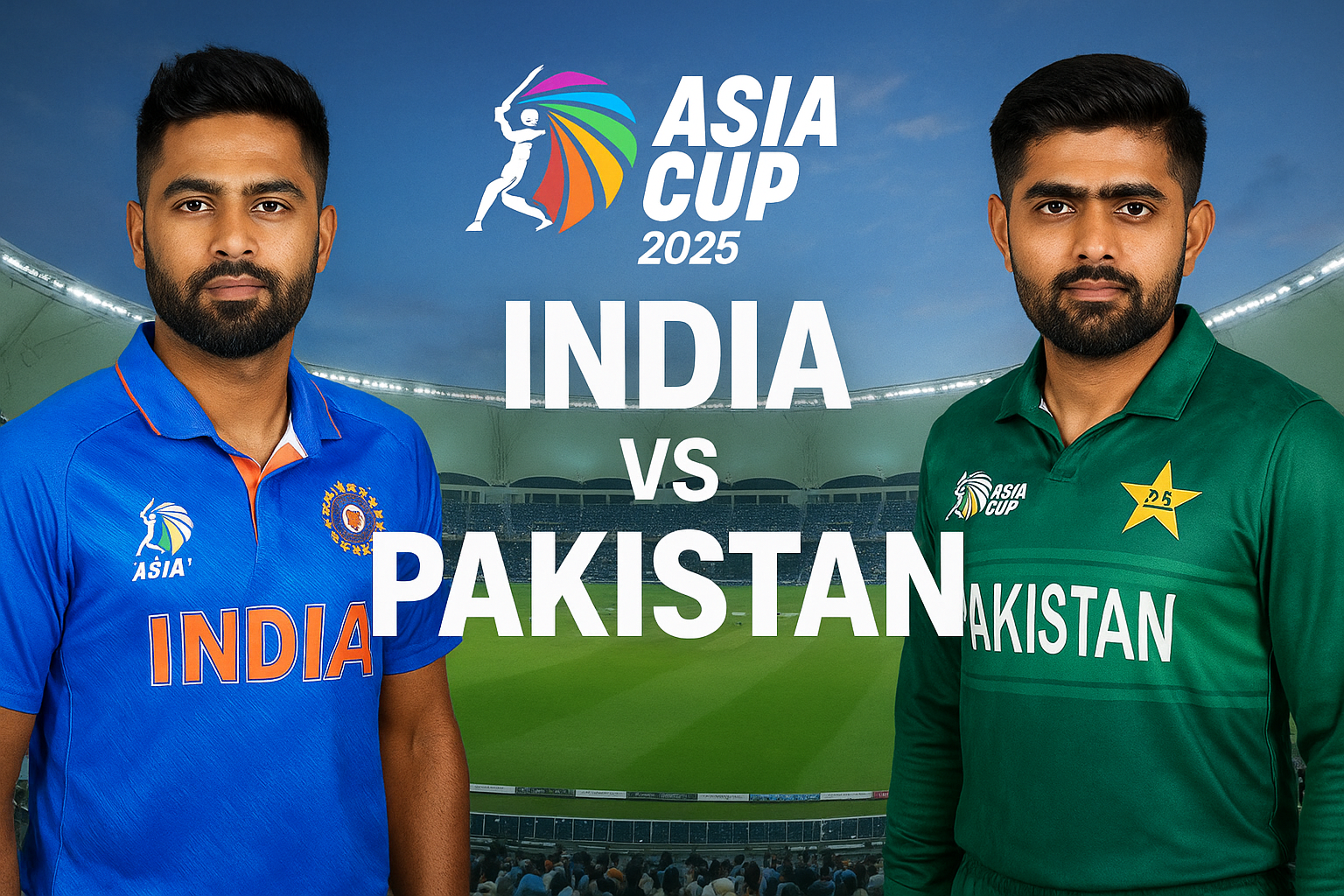
Pakistan vs India Squads for Asia Cup 2025: Head-to-Head Comparison
Detailed comparison of Pakistan vs India squads for Asia Cup 2025. Explore batting, bowling, and all-rounder analysis, strengths, weaknesses, and head-to-head insights.
Introduction — why this matters
India vs Pakistan is more than a cricket match; it’s the continent’s biggest sporting fixture. At the Asia Cup, where regional pride and cricketing form meet, these encounters attract enormous viewership and can define momentum for both teams heading into global events. The 2025 Asia Cup has both teams in Group A alongside Oman and the UAE, with India led by Suryakumar Yadav (captain) and Pakistan led by Salman Ali Agha (captain) — each squad was officially announced by their boards ahead of the tournament. (BCCI.tv, icc)
This article examines both squads in detail, compares roles and potential X-factors, examines head-to-head patterns (especially in T20 and Asia Cup contexts), and offers tactical insight into how each side can tilt the contest. Where helpful, I cite the primary squad announcements and authoritative summaries of the head-to-head record. (BCCI.tv, icc, ESPN Cricinfo)
The squads (official lists — quick reference)
India (selected core names / leadership): Suryakumar Yadav (c), Shubman Gill, Rohit Sharma (note: check captaincy/roles in official release), Jitesh Sharma (wk), Jasprit Bumrah, Arshdeep Singh, Axar Patel, Hardik Pandya (if included), (full squad per BCCI announcement). (BCCI.tv, ESPN Cricinfo)
Pakistan (selected core names / leadership): Salman Ali Agha (c), Shaheen Shah Afridi, Haris Rauf, Hasan Ali, Abrar Ahmed, Fakhar Zaman, Mohammad Haris (wk), Saim Ayub, Mohammad Nawaz, Hasan Nawaz. (full squad per ICC / PCB announcement). (icc)
(Note: full 17-man squads and reserves are available in the official squad pages linked above; those pages are primary references for exact lists and any late replacements.) (BCCI.tv, icc)
Context & form coming into the tournament
- India: Entering the Asia Cup as favourites on paper, India’s T20 depth across batting and spin options has been the major talking point. Selection choices (e.g., the inclusion of Jitesh Sharma and decisions around wrist-spin) suggest the selectors want both power and flexibility in middle overs. The BCCI announcement underlines a balanced mix of senior performers and form players. (BCCI.tv, The Times of India)
- Pakistan: Pakistan’s selection chooses (and sometimes forces) an aggressive attack mentality: a seam battery capable of raw pace and wicket seeking up front, plus leg-spin/left-arm spin options to vary attacking lines. The Pakistan squad announcement highlighted experienced pacers and a sizeable bench of seam all-round options. (icc)
Head-to-head context: in T20 internationals India holds a clear edge historically (roughly 9–10 wins to Pakistan’s 3 in official T20Is), and in Asia Cup encounters India has also had more wins. That historical edge matters psychologically and shapes how Pakistan might plan to unsettle India — by being aggressive early and shaping matchups that neutralize India’s match-winners. (ESPN Cricinfo, myKhel)
India squad — role-by-role analysis
(Assumes the official BCCI list; below I discuss likely roles and tactical usage.)
1) Top order & opening strategy
- Shubman Gill (if included as opener/No. 3): technically compact, runs between the wickets strong, and increasingly looks to play with intent in T20s. Against Pakistan’s new ball seamers (Shaheen, Haris Rauf) Gill’s technique and temperament will be tested early.
- Other options (Rohit / other openers): India traditionally likes an aggressive top order that can exploit powerplay overs. The choice of opening pair will depend on matching seam angles and left/right combinations to disrupt Pakistan’s length.
Why this matters: Pakistan often attacks with left-arm pace (Shaheen) from around the wicket; India must pick an opening combination that neutralizes angle advantages and prevents early wicket losses.
2) Middle order — the core
- Suryakumar Yadav (c): A T20 specialist who plays with innovation and control; his form sets the template for India’s middle overs. As captain (per announcements), his use of powerplay cutters and mid-innings acceleration will be key. (BCCI.tv)
- Finisher options (Hardik, others): India’s depth includes multiple boundary finishers and power-hitter finishers able to manipulate the last-10 overs. India’s ability to rotate the strike and free the boundary options will matter in Dubai’s batting-friendly conditions.
3) Wicketkeeping & backup
- Jitesh Sharma / Sanju Samson: If Jitesh Sharma is in the starting plans (reports suggested Jitesh in XI vs UAE), his selection over Samson indicates a strategic choice for form and glovework; India values a keeper who can accelerate innings and act as a stable middle-order presence. (The Times of India)
4) Spin department
- Axar Patel / other left-arm spinners: India’s finger spin and left-arm spin can tie down runs in middle overs. Wrist-spin options (Kuldeep) — if not selected — change India’s attacking options; selection choices show team balance priorities (control vs wickettaking). (ESPN Cricinfo)
5) Pace attack
- Jasprit Bumrah (if fit) — benchmark death-over and yorker specialist.
- Arshdeep Singh — swing and left-arm variety, useful in powerplay and death overs.
- Backup pacers — India’s bench includes intelligent T20 options to exploit matchups.
Overall India strengths: depth in batting (six capable batters), world-class death bowling if Bumrah fit, versatile spin options, and multiple finishers. Selection indicates a team built to control the innings and accelerate late. (BCCI.tv)
Pakistan squad — role-by-role analysis
(Per ICC/PCB release and media summaries.)
1) Top order & opening strategy
- Fakhar Zaman / Saim Ayub: Pakistan’s opening duo can be explosive. Fakhar is an experienced boundary hitter; Saim Ayub provides nimble left-handed aggression. Pakistan will look to seize early momentum with powerplay hitting. (icc)
2) Middle order & finishing
- Hussain Talat / Mohammad Haris / Sahibzada Farhan: Pakistan’s middle order mixes power and improvisation. There’s an emphasis on players who can finish quickly or hit out of tight situations.
- All-round depth: Faheem Ashraf, Mohammad Nawaz are multi-dimensional players who can bowl and bat in clutch overs.
3) Wicketkeeping & backups
- Mohammad Haris (wk): If selected as keeper, he brings strokeplay and lower-order hitting — Pakistan’s keeper role is more attacking.
4) Spin options
- Abrar Ahmed: A leg-spin/wrist spinner with wickettaking ability. Pakistan has traditionally relied on leg/wrist spin to attack middle overs and force mistakes.
- Mohammad Nawaz: Left-arm orthodox who bowls in the powerplay and middle overs; useful for control and variation. (icc)
5) Pace attack
- Shaheen Shah Afridi: Strike leader, left-arm pace, brings swing and intimidatory bounce. His early overs are crucial.
- Haris Rauf, Hasan Ali: Each brings pace and wicket-taking intent; Pakistan’s death bowling can be lethal when lengths and variations land.
Overall Pakistan strengths: a potent pace battery, multiple seam options, strike bowlers who can produce breakthroughs, and a willingness to play aggressively both with bat and ball. Pakistan’s selection prioritises wickettaking in short bursts rather than conservative containment. (icc)
Direct squad-to-squad comparisons (by role)
Below I compare India vs Pakistan by position/role, highlighting matchups that could decide the September showdown.
Openers (India’s top order vs Pakistan’s opening pace)
- India: technically strong openers with emphasis on rotation and building a platform. If India chooses a mix of Shubman and Rohit/Suryakumar at top, they want control early.
- Pakistan: aggression-first openers (Fakhar, Saim) who look to exploit short boundaries and powerplays.
Matchup insight: Pakistan will try to blast big totals or create scoreboard pressure early; India’s response likely will be to play cautiously in the first 6 overs and take control in the middle overs. Pakistan’s success depends on making the early powerplay count; India’s on surviving it with minimal wickets lost.
Middle order (control vs improvisation)
- India’s middle order (Suryakumar, Axar, finishers): built for control, strike rotation, and planned acceleration.
- Pakistan’s middle order (Harris, Talat, Nawaz): improvisation and power hitting; ability to clear boundary quickly.
Matchup insight: India’s spinners and calm finishers can blunt Pakistan’s middle order risk-taking; Pakistan’s strategy will be to prevent India from settling by taking early wickets and disrupting partnerships.
Spin & spin matchups
- India: variety (left-arm orthodox, finger spinners, wrist potential) designed to stifle runs in the middle overs.
- Pakistan: Abrar Ahmed plus Mohammad Nawaz provide wicketseeking wrist/left-arm options — Abrar especially can be a match-winner.
Matchup insight: Pitch and conditions matter. Dubai/Abu Dhabi typically offer good batting surfaces but have produced turn in evening sessions. Whoever uses spin variations and strategic field placements better will shape the middle overs.
Pace attack vs batting depth
- India pacers: Bumrah (death specialist), Arshdeep (swing), backup seamers who bowl slower off-cutters and execute yorkers.
- Pakistan pacers: Shaheen (early strike), Rauf/Hasan Ali (raw pace), Hasan Nawaz for hitting lengths.
Matchup insight: Pakistan’s ace is early wicket pressure; India’s ace is controlled death bowling. If Pakistan can remove India’s set batters early, they tilt the contest; conversely, if India lasts through the first six and protects against Shaheen’s early swing, they’re likely to control the chase.
X-Factors (players who could tilt the game)
For India
- Suryakumar Yadav (captain & middle-order fulcrum): His 360-degree strokeplay destabilizes bowling plans — he can convert a par total into a match-winning one or anchor a chase. (BCCI.tv)
- Jasprit Bumrah (if fit): Death bowling in T20 is a game of inches; Bumrah’s yorkers and slower ones win close games.
- A support spinner (Axar or wrist option): Could strangle scoring in middle overs and force risky shots.
For Pakistan
- Shaheen Shah Afridi: Early wicket potential; if he strikes in the powerplay, India could be under immediate pressure. (icc)
- Abrar Ahmed: A wrist spinner who can break partnerships; against India’s middle order he is a genuine X-factor.
- Fakhar Zaman / Mohammad Haris: Match-ending hitters who can convert starts into huge scores quickly.
Tactical blueprints — how each team is likely to approach the India vs Pakistan match
Pakistan’s likely plan
- Start fast: Use Shaheen and Haris Rauf to attack the stumps and force early mistakes.
- Target middle overs with wrist spin: Abrar Ahmed will be used to aim for wickets, not merely containment.
- Exploit short boundaries with aggressive batting: Try to post 180+ or chase aggressively.
- Use pace at death: Hasan Ali/Haris Rauf to bowl wicket-taking overs, using bouncers and slower balls unpredictably.
India’s likely plan
- Stabilize early: Let technically sound batters weather the new ball.
- Use spin to control middle overs: Axar and other spinners to choke run rates and force extras or mistakes.
- Finish with planned hitting: Finishers like Hardik (if in squad) to convert hitting power into 40-45 runs in last 4 overs.
- Use precision death bowling: Bumrah & Arshdeep to execute yorkers and cutters.
Historical head-to-head and psychological edges
- T20 head-to-head: India have a significant advantage in T20Is vs Pakistan (India leading roughly 9–10 wins to Pakistan’s 3 across T20I history as recorded by cricket stat authorities). That psychological edge matters because India has repeatedly outplayed Pakistan in limited-overs head-to-heads recently. (ESPN Cricinfo, Olympics)
- Asia Cup head-to-head: In Asia Cup history India also holds more wins than Pakistan; the rivalry’s high-stake history adds pressure and viewership intensity. In Asian contests, Pakistan’s strategy has often been to play fearless cricket and unnerve India early. (myKhel)
Psychological note: Pakistan has historically performed well when playing with a no-fear, attacking mindset; India’s temperament and systematic planning have served well in tight matches. Which team handles pressure better on match day will be decisive.
Player-by-player micro comparisons (key matchups)
Below are head-to-head micro matchups to watch — these are the tactical chess pieces.
1) Shaheen Afridi vs India’s openers / middle order
- Shaheen’s angle from around the wicket to right-handers creates swing and bounce; he aims for early wickets with the new ball.
- Counter: India should use left-right combos (if possible) and patience; key is not to lose wickets to seam movement.
2) Jasprit Bumrah vs Pakistan’s middle order (Haris, Talat)
- Bumrah’s death craft includes wide yorkers and back-of-hand slower balls — especially effective against improv hitters.
- Counter: Pakistan hitters must pick pace changes early; rotating strike rather than going aerial first ball is prudent.
3) Abrar Ahmed vs Suryakumar Yadav
- Abrar’s wrist/spin tries to force false shots from innovative batters.
- Counter: Suryakumar plays late, uses feet well; he must avoid leading with drives and instead pick spin with soft hands or hit over long-on when needed.
4) Mohammad Nawaz vs India’s left-handers
- Nawaz’s left-arm style creates different angles and can tie down scoring on one side.
- Counter: India’s left-handers should use sweep/flick to rotate strike, and target short boundaries when possible.
5) Fakhar Zaman vs Arshdeep Singh (left-arm pace)
- Fakhar’s big hitting thrives on short balls and back-foot boundaries.
- Arshdeep’s control (if used short) may try to deny Fakhar the length for big hits — changes of pace and bouncers are key to curtailing him.
Strengths, weaknesses, and matchup verdicts
India — strengths
- Depth in batting & finishing: Multiple batters capable of rotating strike and power hitting. (BCCI.tv)
- Bowling precision at death (if Bumrah fit) and balanced spin resources.
- Structured game plans and fielding standards.
India — weaknesses / risks
- Vulnerability to early onslaught: If Pakistan gets early wickets with Shaheen and Rauf, India’s middle order can be tested.
- Overreliance on key individuals: If Suryakumar or Bumrah have an off day, India’s balance is tested.
Pakistan — strengths
- Raw pace & wickettaking: Shaheen + Rauf + Hasan Ali present constant threats. (icc)
- Aggressive batting capable of quick recoveries and big totals.
- Spin options for middle overs (Abrar) that can create wickets.
Pakistan — weaknesses / risks
- Inconsistent depth in top order (if early wickets fall).
- Death bowling can be erratic if yorker lengths are poorly executed.
- Fielding and discipline under pressure may be less consistent than India’s.
Matchup verdict (broad)
- On balanced pitches in Dubai/Abu Dhabi, India’s composition (control + finishing) may be marginally superior because of batting depth and death bowling control. But Pakistan’s raw pace and wicketseeking can tilt any match — on their day, Pakistan can win spectacularly. The encounter will likely be decided by who executes their plan in the first 10 overs and how both teams handle pressure in the middle overs.
Tactical scenarios & in-match adjustments (what to watch during the game)
- If Pakistan strikes early (2 wickets inside 6 overs): India must send in a stabilizer (technically correct batter) to rebuild; use spinners early to slow scoring and prevent a chase from getting out of hand.
- If India posts 170–190: Pakistan will play green, attacking cricket; keep spinners in to force risky aerial shots.
- If the toss favors bowl first on a night with dew: Both sides must pick seamers who can bowl through dew and spinners with skid-through options later.
Captaincy decisions to watch: where to use the strike bowlers (Shaheen early or save one over?), when Suryakumar as captain brings himself to bat in pressure, and how field placings manage scoop/scoop-type shots.
Injury watch & selection debates (how selection choices could shape the match)
- India: Availability of Bumrah and any key spinner will change the bowling mix. Team management decisions on playing two vs three seamers affect batting depth.
- Pakistan: Selection of extra seamers vs an additional spinner determines middle-over control vs wicket options.
(Note: boards can announce injury replacements late; always refer to official team pages for last-minute changes.) (BCCI.tv, icc)
Probable XIs and predicted game plan (one plausible scenario each)
India — probable XI (balanced)
- Opener A (Shubman Gill)
- Opener B (Rohit / alternative)
- Suryakumar Yadav (c)
- Middle order batter/keeper (Jitesh Sharma)
- Finisher (Hardik / all-rounder)
- Axar Patel (spin / all-round)
- Specialist spinner (if selected)
- Jasprit Bumrah (death)
- Arshdeep Singh (swing)
- Support pacer
- Backup seamer / all-rounder
Plan: Survive powerplay, control middle overs with spin, and finish strongly.
Pakistan — probable XI (aggressive)
- Fakhar Zaman
- Saim Ayub
- Middle order power batter (Hussain Talat / Mohammad Haris)
- Salman Ali Agha (c / all-round)
- Mohammad Nawaz (left-arm spin + bat)
- Abrar Ahmed (wrist spin)
- Shaheen Afridi (strike)
- Haris Rauf / Hasan Ali (pace attack)
- Hasan Nawaz or other seamer
- Wicketkeeper (Mohammad Haris or designated)
- Finisher / bench option
Plan: Attack from the outset, use pace to force collapse, exploit short balls.
(These are illustrative; actual XIs depend on final selection & pitch report.) (icc, BCCI.tv)
Statistical snapshot — head-to-head & key records (quick facts)
- T20 head-to-head: India historically lead Pakistan in T20Is (India ~9–10 wins; Pakistan ~3 wins in official T20Is). This trend gives India a statistical edge in the shortest format. (ESPN Cricinfo, Olympics)
- Asia Cup meetings: India have historically won more Asia Cup matches against Pakistan; these continental contests carry added significance. (myKhel)
(For exhaustive stats — individual highest scores, most wickets in IND-PAK T20s, and match lists — check ESPNcricinfo’s head-to-head pages and the tournament squad pages.) (ESPN Cricinfo, Cricbuzz)
How conditions (Dubai / Abu Dhabi) might influence the clash
- Pitches: Generally batting-friendly with predictable bounce; night games can have a bit of dew making spin less effective in the second innings.
- Weather: Warm nights, dew factor later — captains winning toss might prefer to bowl first if significant dew is expected.
- Boundary sizes: Stadiums in UAE vary; smaller boundaries favor big hitters (Pakistan advantage); larger boundaries favor teams with rotation and placement (India advantage).
Matchcraft note: If dew is expected, spinners may be used earlier and more seamers preserved for later — captaincy and bowling change timing will be critical.


Final strategic recommendations (for each team)
For India
- Preserve wickets in powerplay and avoid panic against early pace bursts.
- Use spin proactively in overs 7–15 to control run flow and force risky shots.
- Execute death bowling plans with practiced yorkers and precise slower balls.
For Pakistan
- Exploit early overs with Shaheen and Rauf to unsettle India’s top order.
- Rotate spinners and pacers cleverly: Abrar should be used to force wickets in middle overs, with pace to finish.
- Keep batting aggressive yet smart—turn starts into long partnerships rather than throwing away wickets.
Conclusion — who has the edge?
If everything goes on paper, India’s balance (batting depth + death bowling craft) gives them a slight edge — particularly on surfaces that reward controlled batting and smart spin use. However, cricket is a daily sport: Pakistan’s raw pace attack and explosive batting make them a constant threat — a few good overs from Shaheen/Abrar or a big innings from Fakhar/Mohammad Haris can invert expectations. Ultimately, the match will be decided by execution: early overs (powerplay), middle-over control, and death bowling precision. (BCCI.tv, icc)
Sources & where to read more (selected primary references)
- BCCI: India’s official squad announcement. (BCCI.tv)
- ICC / PCB: Pakistan’s official squad announcement and ICC summary. (icc)
- Cricbuzz / ESPNcricinfo: Full squads, matchups, and tournament coverage. (Cricbuzz, ESPN Cricinfo)
- Head-to-head statistics and historical T20 records: ESPNcricinfo head-to-head records. (ESPN Cricinfo)