





England Announce Playing XI for First T20 Against South Africa 2025 | Full Analysis & Player Breakdown
England have confirmed their playing XI for the first T20I against South Africa in Cardiff. Phil Salt returns, Harry Brook leads as captain, Sam Curran makes his comeback, and Jofra Archer spearheads the bowling attack. Full analysis, player roles, and what it means for England’s T20 World Cup 2026 roadmap.
Introduction: The Road to Cardiff and Beyond
Cricket is not just a game in England—it is a story woven into the cultural fabric of the nation. Over the last decade, the England cricket team has been through radical transformations, particularly in white-ball formats. After the heartbreak of the 2015 Cricket World Cup, the English set-up reinvented itself, building one of the most dynamic limited-overs sides in history. That renaissance culminated in their 2019 ODI World Cup triumph and 2022 T20 World Cup glory.
Now, in September 2025, England once again find themselves in a phase of recalibration. With the 2026 ICC T20 World Cup in India and Sri Lanka fast approaching, every bilateral series, every squad announcement, and every match feels like a step in that larger journey. Against this backdrop, the first T20 International between England and South Africa in Cardiff has assumed significance that extends beyond just the immediate contest.
The England and Wales Cricket Board (ECB) made headlines by announcing the official playing XI ahead of the Cardiff clash. Selections were not just routine confirmations; they reflected a blend of continuity, calculated risk, and bold experimentation. For fans, analysts, and critics alike, the XI unveiled by England has sparked debates about balance, intent, and the roadmap for the months ahead.
Let us dive deep into the confirmed XI, the thinking behind it, the roles of individual players, the tactical blueprint for the series, and the broader implications for England’s white-ball ambitions.


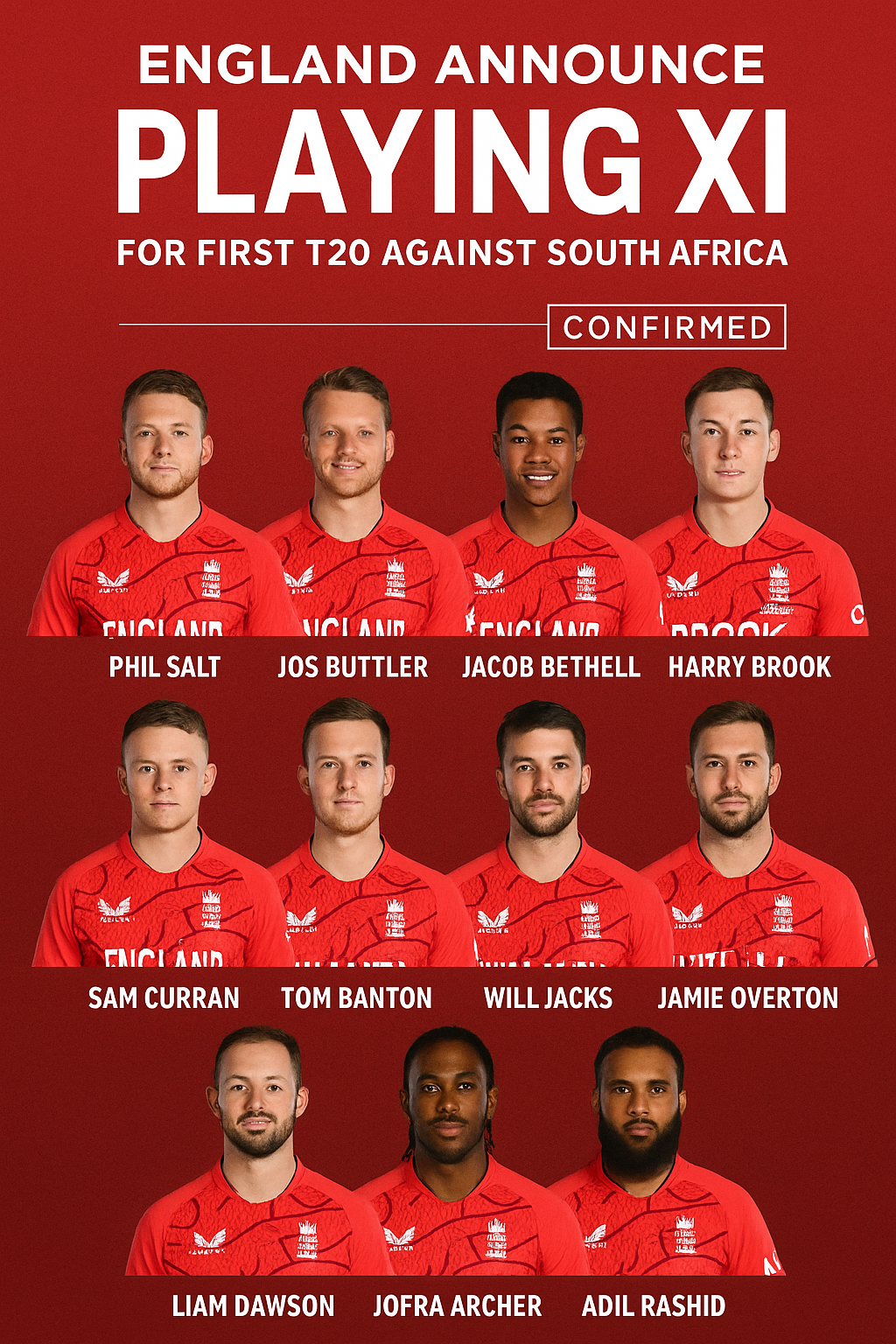
The Confirmed England XI for the First T20I
England’s lineup for the Cardiff T20I is as follows:
- Phil Salt (Opener)
- Jos Buttler (Wicketkeeper & Opener)
- Jacob Bethell
- Harry Brook (Captain)
- Sam Curran
- Tom Banton
- Will Jacks
- Jamie Overton
- Liam Dawson
- Jofra Archer
- Adil Rashid
This XI immediately captures attention for a few reasons: the return of Sam Curran, the presence of multiple spin options, the choice of Buttler as opener alongside Salt, and the youth-meets-experience approach that the management has embraced.
Player-by-Player Breakdown
1. Phil Salt – The Aggressive Opener Returns
Phil Salt has carved a reputation as one of England’s most destructive white-ball openers in recent years. His fearless batting style has made him a fan favorite, particularly in T20 cricket, where powerplay dominance often decides outcomes.
Salt missed part of England’s summer cricket due to paternity leave but returned strongly in domestic competitions, particularly The Hundred, where he topped run charts with explosive innings. His recall is not just based on potential—it’s based on form and necessity.
England has at times struggled with inconsistent starts in the T20 format. Salt’s ability to clear the infield in the first six overs complements Jos Buttler’s calculated aggression. Together, they form a partnership capable of demolishing any bowling attack, including South Africa’s pace-heavy lineup.
2. Jos Buttler – The Experienced Wicketkeeper Opener
Jos Buttler’s name is synonymous with England’s white-ball revolution. Once a middle-order finisher, Buttler reinvented himself as one of the world’s most dangerous openers. His ability to adapt—whether consolidating after early wickets or accelerating from the first ball—makes him invaluable.
For this series, Buttler has been entrusted with the dual responsibility of opening and wicketkeeping, while also guiding young captain Harry Brook as a senior leader. His strike rate of over 140 in T20 internationals demonstrates his ability to not just anchor but dominate innings. Against South Africa, Buttler’s experience of facing Kagiso Rabada, Anrich Nortje, and Tabraiz Shamsi will be crucial.
3. Jacob Bethell – A Rising Star in the Middle Order
Jacob Bethell is one of the most intriguing inclusions. The young Barbadian-born left-hander, who came through England’s under-19 system, brings fresh energy to the middle order. Known for his all-round skills, Bethell can anchor or accelerate, depending on the match situation.
His role at No. 3 is particularly significant. England has often lacked a reliable stabilizer after the openers. Bethell’s technique against spin and ability to rotate strike make him a strong candidate for that role. Additionally, his part-time left-arm spin offers variety, especially on slower Cardiff surfaces.
4. Harry Brook – The Captain and Future of English Cricket
Handing the captaincy to Harry Brook is both symbolic and strategic. Symbolic because it represents a generational shift; strategic because Brook embodies the fearless, aggressive style England wants to continue.
Brook’s batting exploits across formats have been sensational. His adaptability in T20 cricket—whether in the IPL, The Hundred, or for England—has made him a superstar. At No. 4, he provides stability but also the ability to launch counter-attacks.
As captain, Brook will be tested tactically against a seasoned South African side. His bowling changes, field placements, and ability to manage pressure will reveal much about his leadership credentials heading into the World Cup.
5. Sam Curran – The All-Rounder Reborn
One of the most talked-about selections is the return of Sam Curran. Out of the England setup since November 2024, Curran’s recall is a reward for his brilliant form in domestic cricket.
Curran offers England the elusive balance every T20 team craves:
- A left-handed power-hitter capable of scoring quick runs at No. 5 or 6.
- A reliable death bowler with variations, yorkers, and slower balls.
- A high-energy fielder.
Curran was the Player of the Tournament in the 2022 T20 World Cup, and England will hope he rediscovers that magic. His presence also allows flexibility in team balance, freeing up other bowlers to attack in different phases.
6. Tom Banton – The Unorthodox Finisher
Tom Banton’s career has been a mix of dazzling highs and frustrating lows. But when on song, Banton is one of the most innovative batsmen in world cricket, capable of scoops, reverse sweeps, and fearless hitting.
His role in this XI is likely that of a middle-to-lower order aggressor, finishing innings alongside Curran and Jacks. The Cardiff pitch, often favoring batters later in the innings, could suit Banton’s game. This series feels like a crucial opportunity for him to cement his spot in England’s T20 setup.
7. Will Jacks – The Versatile Power-Hitter
Will Jacks has been England’s utility man for the last couple of seasons. A clean striker of the ball and a handy off-spinner, he provides depth on both fronts.
In this XI, Jacks is likely to float in the batting order—used as a pinch-hitter if early wickets fall or as a late finisher. His off-spin is also vital, especially when paired with Adil Rashid and Liam Dawson, giving England up to four spin-bowling options.
8. Jamie Overton – The Pace Enforcer
Jamie Overton may not yet be a household name in England’s T20 setup, but his raw pace and bounce make him a potent weapon. Bowling consistently above 140 km/h, he adds aggression to the attack.
Overton’s role will be to complement Jofra Archer with the new ball and bowl hostile middle overs. His batting—often underrated—also provides late-order hitting depth. In modern T20 cricket, multi-dimensional cricketers like Overton are invaluable.
9. Liam Dawson – The Control Spinner
Liam Dawson’s inclusion might surprise some, but his role is clear: control. While Adil Rashid provides wicket-taking flair, Dawson brings discipline, economy, and the ability to bowl in the powerplay if required.
In Cardiff, where pitches can assist spinners, Dawson’s role will be critical in tying down South African batters like Quinton de Kock and Rassie van der Dussen. His batting, though not explosive, adds depth.
10. Jofra Archer – The X-Factor
Few names excite England fans as much as Jofra Archer. After years of injury struggles, Archer’s gradual return has been carefully managed. Now, he is once again leading England’s T20 bowling attack.
Archer brings:
- Express pace.
- Death-overs precision.
- Experience of IPL and global leagues.
- The ability to intimidate opponents.
His battle with South Africa’s big hitters will be one of the highlights of the series. England will hope Archer remains fit and firing—his presence could be the difference between success and mediocrity in the lead-up to the T20 World Cup.
11. Adil Rashid – The Spin Maestro
Adil Rashid remains England’s premier spinner across formats. His leg-spin has been England’s go-to weapon in T20s, particularly against teams that struggle against wrist-spin.
Rashid’s value lies not just in wickets but in timing. Brook can deploy him to break partnerships in the middle overs or even use him in the powerplay. His partnership with Dawson and Jacks gives England unmatched spin variety.
Tactical Blueprint: How England Might Play
Batting Strategy
- Open aggressively with Salt and Buttler.
- Use Bethell and Brook to stabilize the middle.
- Allow Curran, Banton, and Jacks to finish explosively.
Bowling Strategy
- Archer and Overton with the new ball.
- Spin choke in the middle: Rashid, Dawson, Jacks, Bethell.
- Curran and Archer at the death.
This mix provides England with flexibility depending on conditions.
Historical Rivalry: England vs South Africa in T20s
England and South Africa have produced some classic T20 battles. From the 2016 T20 World Cup group-stage thriller to bilateral series in England and South Africa, contests have often been close.
Historically, England has had the edge in big moments, particularly with Buttler and Rashid playing decisive roles. Cardiff 2025 adds another chapter to this rivalry.
Expert and Media Reactions
Pundits have largely praised England’s XI, calling it a “balanced blend of youth and experience.” Some critics, however, argue that resting Ben Duckett and Jamie Smith removes stability.
Analysts highlight the unusual inclusion of four spinners—a sign that England is experimenting with combinations ahead of subcontinent conditions in 2026.
Broader Implications: Road to T20 World Cup 2026
This XI is not just about one match—it is about preparing for the World Cup. England is clearly:
- Building depth in batting.
- Experimenting with multiple spin options.
- Testing Brook’s captaincy.
- Reinforcing Archer and Curran as core white-ball assets.
If successful, this blueprint could define England’s approach over the next year.
Conclusion: A Statement of Intent
England’s announced XI for the first T20 against South Africa is more than a team sheet—it is a statement of intent. It reflects ambition, experimentation, and preparation for the future.
With Salt and Buttler at the top, Brook leading boldly, Curran returning, Archer firing, and Rashid weaving his magic, England looks ready to entertain and dominate.
The Cardiff clash will provide immediate answers—but the long-term message is clear: England is preparing for sustained white-ball dominance, with eyes firmly set on the 2026 T20 World Cup.