

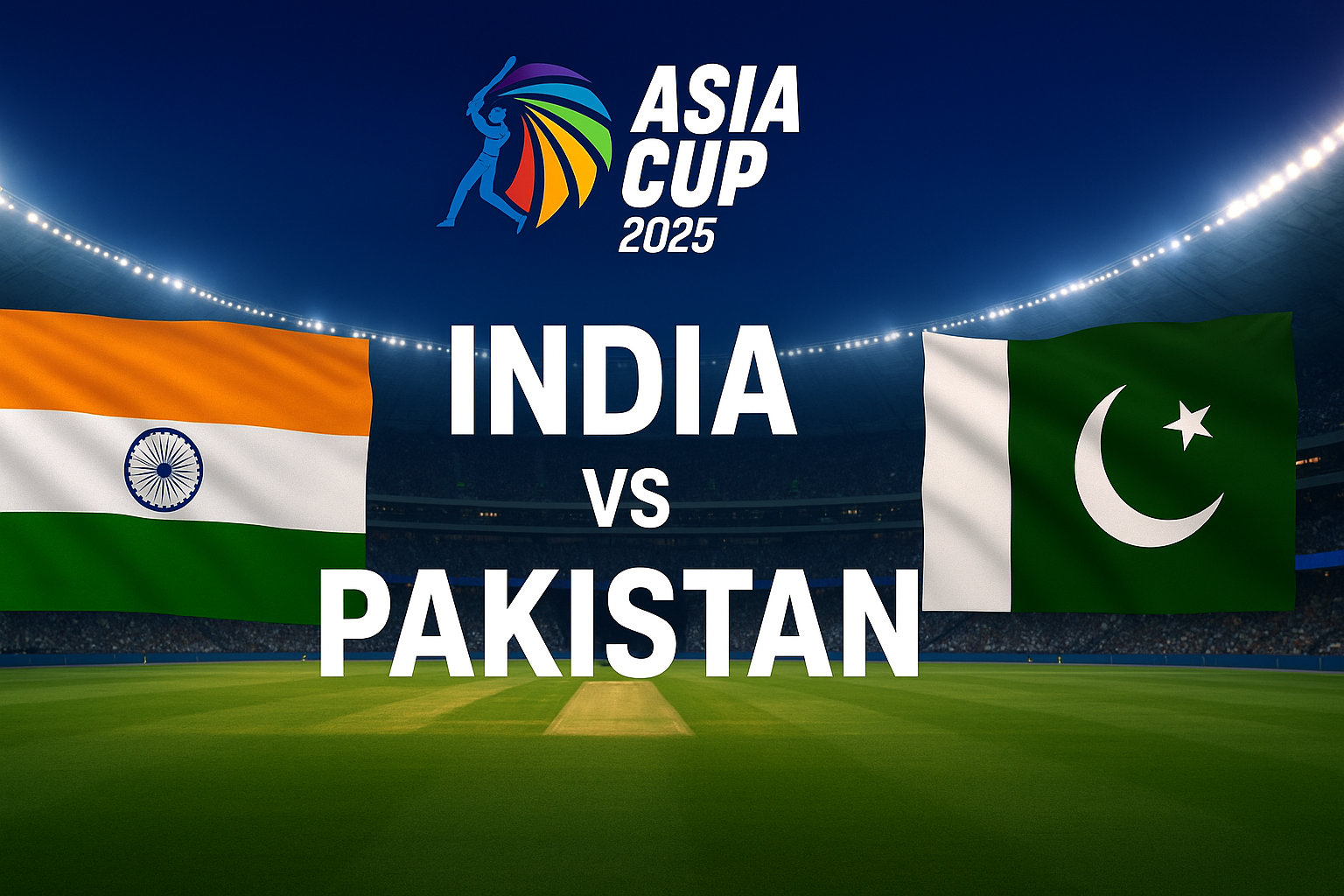
India vs Pakistan – The Biggest Rivalry of Asia Cup 2025
India vs Pakistan in Asia Cup 2025: The biggest rivalry in cricket. Explore history, hype, stats, fan culture & what’s at stake in Dubai.
Introduction: A Clash Beyond Cricket
Few rivalries in world sport evoke the kind of emotions that the India vs Pakistan cricket rivalry does. It is not merely a contest between two teams; it is a spectacle that brings entire nations to a standstill, an event that binds billions of hearts with the string of anticipation, pride, and nervous energy.
The Asia Cup 2025, hosted in the United Arab Emirates from September 9 to 28, is more than just another edition of a continental tournament. For cricket fans across the globe, this year’s competition carries an added weight because of one match in particular—India vs Pakistan.
Scheduled for September 14, 2025, in Dubai, the group-stage encounter promises to be the highlight of the tournament. With both sides expected to progress, the possibility of meeting again in the Super Four and potentially in the final on September 28 adds layers of excitement. This sets up a tantalizing prospect of witnessing the two sides clash up to three times in less than a month.
But the story of this rivalry is not confined to cricketing statistics. It is a saga where politics, history, and national identity merge with sporting brilliance, making every delivery bowled and every run scored a matter of pride far beyond the boundaries of the cricket field.
Chapter 1: The Historical Context of the Rivalry
Early Encounters
The cricketing rivalry between India and Pakistan began in 1952 when Pakistan toured India for their first-ever Test series. Since then, every bilateral or tournament clash has been more than just about cricket—it has been about prestige.
Over the decades, matches between the two nations have become mini-festivals. Streets empty, offices slow down, and households gather around televisions or radios. For the diaspora in the UK, USA, Canada, and the Middle East, these games are moments of nostalgia and collective identity.
Asia Cup Battles
The Asia Cup, introduced in 1984, has been a crucial stage for Indo-Pak encounters. Both teams have lifted the trophy multiple times—India with 7 titles and Pakistan with 2 titles—but every time they meet, the result overshadows the tournament itself.
Notable Asia Cup matches include:
- 1986, Sharjah: Javed Miandad’s iconic last-ball six against Chetan Sharma became a cultural moment for Pakistan.
- 2010, Dambulla: Harbhajan Singh’s last-over heroics sealed a nail-biting win for India.
- 2022, Dubai: Virat Kohli’s comeback knock against Pakistan in T20 format showcased India’s resilience.
These games remain etched in fans’ memories, fueling the fire each time the two nations meet again.
Chapter 2: The Political Backdrop – Cricket in the Shadow of Tensions
The India-Pakistan rivalry cannot be discussed without acknowledging the political realities. The relationship between the two nations has historically been tense, with conflicts and disputes often spilling over into cricket.
Boycott Calls and Legal Challenges
In 2025, the rivalry is once again under a spotlight beyond sport. Following cross-border incidents earlier in the year, there were calls for India to boycott Pakistan in the Asia Cup. A Public Interest Litigation (PIL) was even filed in India’s Supreme Court seeking the cancellation of the fixture.
However, cricketing bodies stood firm. The Board of Control for Cricket in India (BCCI) emphasized that withdrawing from the match would amount to conceding a walkover, which could damage India’s standing in the tournament. Thus, despite political friction, cricket prevailed.
Symbolism of Encounters
Every handshake, every gesture, every word exchanged between Indian and Pakistani players is scrutinized. During the 2025 build-up, a handshake between India’s captain Suryakumar Yadav and a Pakistani minister became controversial after being linked to past political rhetoric. It highlighted how even the simplest actions take on magnified meanings in this rivalry.
For fans, the matches are not just about runs or wickets—they are symbolic victories that provide a sense of national pride.
Chapter 3: Tournament Framework – The Stage is Set
The Asia Cup 2025 format adds to the drama:
- Group A: India, Pakistan, Nepal, Oman
- Group B: Sri Lanka, Afghanistan, Bangladesh, UAE
The top two from each group advance to the Super Four, where the teams play in a round-robin format before the final on September 28.
The schedule ensures that India and Pakistan will meet at least once, and if both teams qualify, they are almost certain to clash again. Broadcasters and advertisers anticipate record-breaking viewership, while fans brace for back-to-back high-stakes encounters.
Chapter 4: Build-Up – Form and Momentum
India’s Form
India entered the tournament in blistering form. Their group opener against UAE was a display of sheer dominance:
- Chasing a small total, India reached the target in just 4.3 overs, registering their fastest successful T20 chase.
- Captain Suryakumar Yadav and opener Yashasvi Jaiswal showcased aggression, while bowlers like Jasprit Bumrah and Arshdeep Singh suffocated the opposition.
The message was clear: India meant business.
Pakistan’s Preparation
Pakistan’s strength has traditionally been in their fast-bowling arsenal. With Shaheen Afridi, Naseem Shah, and Haris Rauf leading the attack, they possess the firepower to trouble any batting lineup. Their batting revolves around Fakhar Zaman and Agha Salman, while young guns like Saim Ayub add flair.
For Pakistan, beating India is not just a sporting ambition—it’s a psychological necessity to prove their mettle against their biggest rivals.
Chapter 5: The Matchday Atmosphere
Imagine Dubai International Stadium on the evening of September 14, 2025. The stands are a sea of blue and green, flags waving, drums beating, and chants echoing. The global diaspora turns the neutral venue into a carnival, with equal representation from both nations.
Security is tight, emotions run high, and broadcasters know they are airing one of the most-watched events in world sport.
For the players, the challenge is mental. Handling the pressure of a billion expectations requires not just skill but extraordinary composure. A dot ball, a misfield, or a boundary can trigger seismic shifts in momentum and crowd noise.
Chapter 6: Cricketing Duels – India vs Pakistan Battles Within the Battle
Some match-ups define Indo-Pak clashes:
- Shaheen Afridi vs Shubman GIll: Afridi’s ability to swing the new ball has troubled Shubman before. Can the Indian captain overcome this threat?
- Jasprit Bumrah vs Fakhar Zaman: Two modern greats in their prime. Every delivery in this duel feels like a mini-final.
- Hardik Pandya vs Pakistan’s middle order: Pandya’s role as a finisher and seam bowler makes him crucial in breaking Pakistan’s rhythm.
These battles within the battle often decide the match outcome.
Chapter 7: Media Frenzy and Fan Culture
No other cricket rivalry attracts as much media attention. In India and Pakistan, television debates, social media memes, and fan campaigns dominate the narrative weeks before the game.
- Viewership Records: Indo-Pak matches often attract over 300 million global viewers, surpassing even World Cup finals between other teams.
- Economic Impact: Sponsorship rates skyrocket. Advertisers pay record fees for 10-second slots during these matches.
- Fan Stories: From crowded tea shops in Lahore to corporate boardrooms in Mumbai, life pauses when the game begins.
For the diaspora, especially in Dubai, London, and New York, these matches are communal events that rekindle a sense of identity.
Chapter 8: Potential Rematches – Super Four and the Final
The group-stage clash is only the beginning. Both India and Pakistan are expected to progress, making a Super Four encounter likely. And if destiny aligns, a final showdown on September 28 could become the most significant match of the decade.
The prospect of facing the same rival multiple times in a short span adds intensity. Teams must adapt strategies, counter rival strengths, and maintain psychological composure.
Chapter 9: Beyond the Boundary – Broader Implications
Impact on T20 World Cup 2026
The Asia Cup serves as a precursor to the T20 World Cup 2026. Performances here will influence selections, strategies, and momentum.
India vs Pakistan Cricket Diplomacy
Indo-Pak encounters are often viewed as opportunities for “cricket diplomacy.” A handshake, a shared smile, or an exchange of jerseys can soften political narratives, if only temporarily.
India vs Pakistan Cultural Identity
The rivalry reinforces national identity. Victories are celebrated as more than just sporting wins; defeats often spark debates that go far beyond cricket.
Chapter 10: Conclusion – More Than a Game
The India vs Pakistan clash in the Asia Cup 2025 is more than a sporting contest. It is a phenomenon that combines history, politics, economics, and culture into a single event.
For players, it is the ultimate test of skill and temperament. For fans, it is an emotional rollercoaster. For cricket, it is the match that proves why the game is called the sport of emotions.
Whether it’s Rohit Sharma lifting his bat after a cover drive, or Shaheen Afridi roaring after a wicket, every moment will become a memory, every frame a story, and every result a headline.
Because when India meets Pakistan, cricket transforms into the biggest rivalry in the sporting world—one that defines generations, transcends borders, and continues to remind us that sometimes, a cricket match is never just a cricket match.


